Description
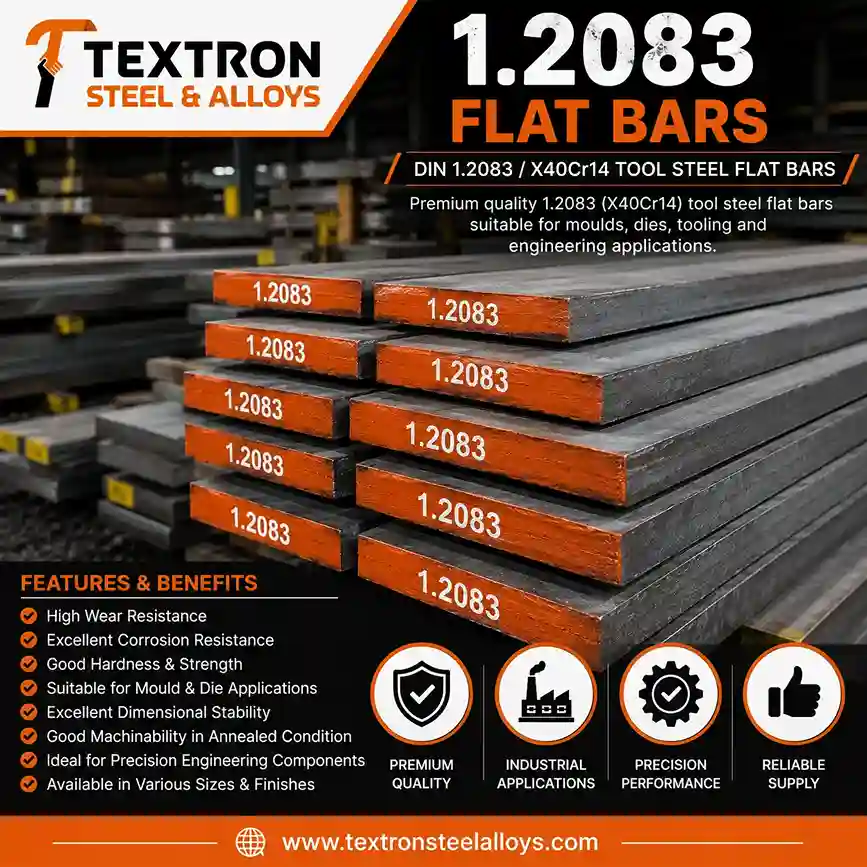
1.2083 Flat Bars / DIN 1.2083 Flat Bar
1.2083 Flat Bars are suitable for manufacturing moulds, dies, tooling components, machine parts and other precision engineering components. Material can be supplied as per customer requirements and applicable material specifications.
M/s Textron Steel and Alloys is a supplier and stockist of 1.2083 Flat Bar, offered in different sizes, thicknesses, widths, lengths, finishes and supply conditions. DIN 1.2083 is a chromium-alloyed tool steel commonly selected for applications requiring good wear resistance, hardness and corrosion resistance.
What is 1.2083 Flat Bar?
1.2083 Flat Bar is a flat-section steel product manufactured from grade 1.2083 tool steel. The material is widely associated with chromium alloy tool steels used for moulds, dies and tooling applications.
The flat bar configuration makes the material convenient for machining into mould plates, inserts, tool components, wear parts and other components where a rectangular cross-section is required.
Depending on the application, 1.2083 Tool Steel Flat Bars can be supplied in annealed, hardened and tempered or other agreed conditions.
1.2083 Chemical Composition :
| Elements | Min. | Max. |
| C | 0.36 | 0.42 |
| Si | – | 1.00 |
| Mn | – | 1.00 |
| Cr | 12.50 | 14.50 |
| P | – | 0.030 |
| S | – | 0.030 |
Features of 1.2083 / X40Cr13 Grade :
The major characteristics of 1.2083 Flat Bars include:
• Good wear resistance
• Good hardness after heat treatment
• Good corrosion resistance compared with conventional carbon tool steels
• Suitable for mould and tooling applications
• Good machinability in suitable annealed condition
• Good dimensional stability when properly heat treated
• Suitable for polishing applications
• Available in multiple flat bar dimensions
• Suitable for machining and precision engineering
• Can be supplied in cut-to-size lengths
Applications of 1.2083 Tool Steel :
1.2083 Round Bar / Flat Bars are used in a wide range of industrial and engineering applications, particularly where hardness, wear resistance and corrosion resistance are required.
Typical applications include:
• Plastic moulds
• Injection mould components
• Compression moulds
• Mould inserts
• Die components
• Tooling components
• Cutting and forming tools
• Precision machine components
• Wear-resistant components
• Engineering components
• Jigs and fixtures
• Industrial tooling
• Mould bases and associated components
• Components requiring polished surfaces